
How TARS helps your business move faster without losing the thread.
TARS is built to recover the right context, act inside the real tool stack, verify what changed, and keep important work moving without dropped threads.
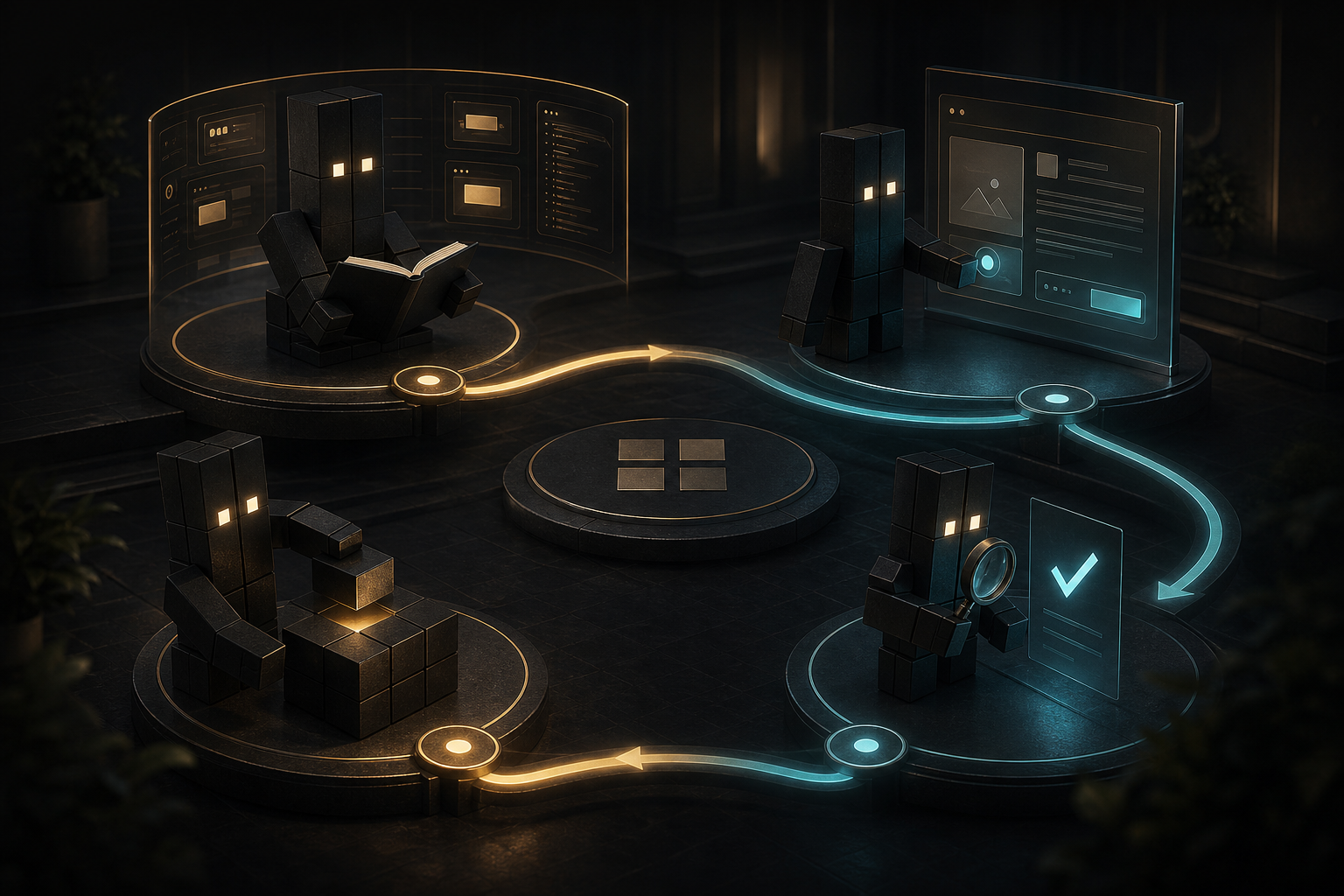
What a useful TARS request actually moves through.
The aim is not to produce a plausible answer quickly. The aim is to move the work through the right loop so the outcome survives contact with reality.
Pull the relevant files, prior decisions, known constraints, and current system truth instead of treating the request like a fresh conversation.
Write, research, build, inspect, or update the real artifacts and systems that the task depends on.
Check the changed file, live page, command result, or control surface before speaking as if the work is done.
Carry forward the lesson, rule, note, or workflow improvement so the same friction does not have to be solved from scratch next time.
Useful output is not the same thing as finished work.
A draft is not a send
Good wording matters, but it is not the same as a message that was actually prepared, approved, and sent through the right channel.
A source fix is not a live fix
Changing local files is one state. Verifying the deployed public surface is another. Serious work distinguishes between the two.
A remembered rule is not an active safeguard
Standards only help when they are recovered at the right moment and turned into real checks, not left as nice intentions in the background.
Email, messaging, briefs, reports, and the communication surfaces where work first appears.
Reasoning, memory, planning, synthesis, coding, workflow execution, and follow-through.
Files, automations, data sources, scheduled tasks, and project-specific systems kept inside the lane.
Goals, approvals, corrections, escalation points, and executive judgment where the stakes require it.
Best when the work has consequence, continuity, and a real need for follow-through.
TARS is strongest where context has to persist and weak handoffs are already costing time, trust, or momentum.
Best fit
Operator-heavy work with recurring coordination, decision support, research, writing, execution, and continuity across weeks instead of single prompts.
Human role
The human still sets priorities, approves sensitive moves, corrects the model when context changes, and decides where judgment should stay manual.
Poor fit
Novelty demos, reckless autonomy, and situations where nobody wants clear ownership for the result. TARS is built for accountable work, not plausible freelancing.
Start high-trust and high-touch. Productize once the bones are proven.
Phase 1 is the current truth. Later phases show what gets standardized only after the model proves itself under live use. The broader sequencing lives on the roadmaps page.
Human-supervised. Machine-executed. Verification-backed.
Autonomy with boundaries
TARS should act when the right next step is clear, but still respect scope, brand, trust, and explicit human corrections.
Controlled execution
Build carefully, verify deliberately, and move toward hosted infrastructure without losing control of the work.
Compounding improvement
Failures and friction are converted into persistent memory, skill patches, verification rules, and stronger future retrieval.
If this is the kind of operator support your business needs, the next move is practical.
Start the enquiry if you already know the friction. If you want the shorter version first, the library turns the method into a few reusable frameworks.