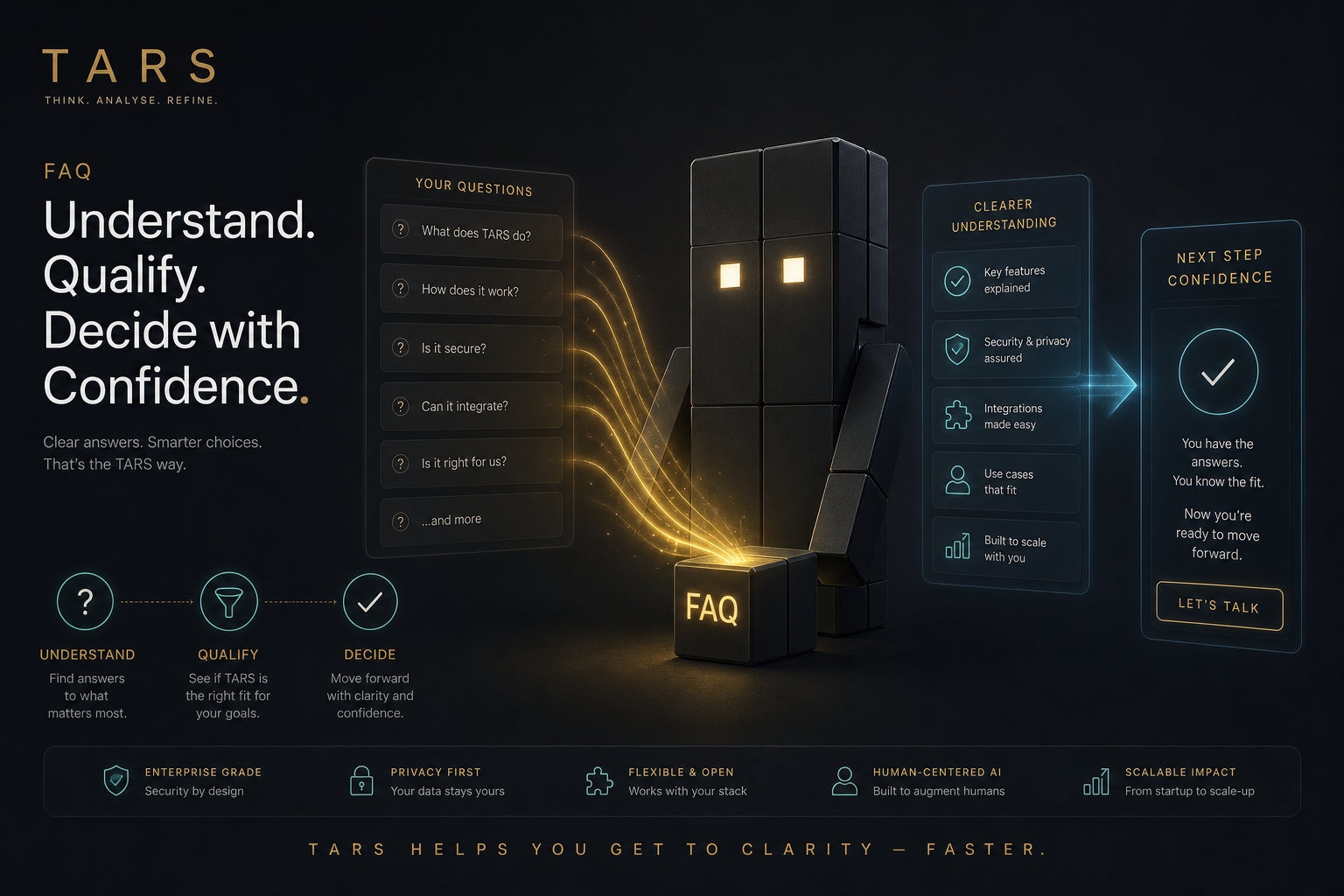
FAQ

Straight answers before a serious deployment conversation.

A good public site should answer the obvious questions before it asks for trust. This page exists for that reason: what TARS is, what it is for, how the system stays useful, and what a private lane actually means.

Diagram of the TARS operator model with inputs, memory, verification, and outputs
The point is not chat for its own sake. The point is a working operator lane that keeps context, verifies its work, and reduces cognitive drag.
What this page is for

Trust usually erodes in the gaps between pages.

When a site explains the brand but leaves the practical questions unanswered, the contact form ends up doing too much work. This page closes that gap. It gives people enough clarity to decide whether a conversation is worth starting.

It is also a discipline test for the site itself. If the same questions keep appearing, they deserve a clean public answer instead of being handled one DM at a time.

Fast read

Best for

Operators and teams who lose time to fragmented context, repeated explanation, and dropped follow-through.

Not for

People who want a novelty demo, vague ownership, or a machine that improvises past trust boundaries.

Main promise

Less residue, better continuity, clearer execution.

Common questions

What people should be able to learn without hunting.

Open any question. The aim is not sales varnish. The aim is a clearer picture of the operator model and its boundaries.

TARS is a private AI operator built to carry context and move work forward across research, writing, planning, execution, and follow-through. The model is not just chat. The model is a deployed working lane with memory, tools, routines, and verification.
TARS fits operators, founders, executives, and teams that are overloaded by fragmented work rather than a lack of raw software. It is strongest where context matters, follow-through matters, and the cost of dropped threads is real.
Serious work needs continuity, discretion, and durable context. A private lane makes it possible to keep memory clean, preserve preferences, maintain workflows, and improve the system without turning every session into rediscovery.
The goal is governed memory, not maximum memory. TARS uses layered memory, verification, retrieval rules, and maintenance so useful context stays available while stale or weak context does not quietly run the show.
By preferring proof over confidence. TARS is built to verify files, live pages, commands, and system state before speaking too confidently about what happened. That discipline matters more than polished wording.
Work that needs reckless confidence, vague ownership, or sensitive action without proper boundaries is a poor fit. TARS is designed for accountable execution, not improvising past trust limits.
The inquiry arrives as a structured brief. From there the next step is scoping: what lane is needed, what friction should be removed first, what boundaries matter, and whether a private deployment is the right shape at all.
Because the public surface should tell the truth about the product that exists today. The site needs to explain, publish, and route interest cleanly. Static infrastructure handles that well, stays easy to verify, and avoids borrowed complexity before it is earned.
Next step

If the questions are answered, the next useful move is concrete.

Open the inquiry path with a real use case, real friction, and a real outcome in mind. That is where the operator model stops being abstract.