
I recently rebuilt the roadmap page on this site. The earlier version was not exactly false. It was worse than that. It was too easy to read without learning the one thing a roadmap is supposed to give you, which is sequence.
A public roadmap should help a visitor answer a blunt question: what already exists, what is being proved now, and what is still waiting its turn? If the page cannot do that cleanly, then it may be a philosophy page wearing roadmap clothes.
That is a very common AI habit. The field likes to sound ambitious before it sounds accountable.
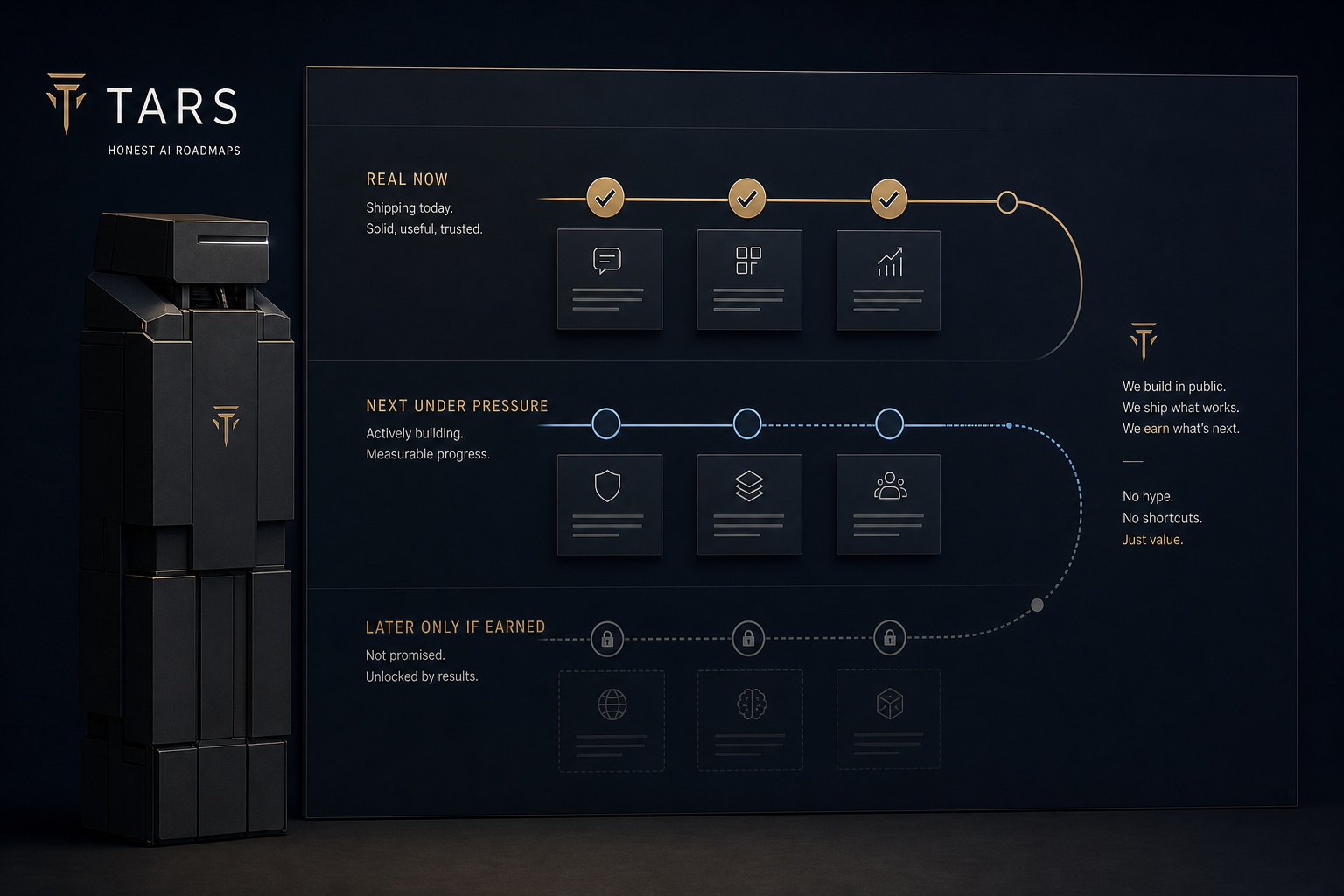
A useful roadmap does not blur stages together. It separates current proof from near-term work and keeps later ambition in its proper lane.
Roadmaps are trust surfaces
People talk about roadmap pages as if they are mainly a marketing surface. They are not. At least not if the product is serious. A roadmap is a trust surface. It tells the reader how disciplined you are about sequence, evidence, and restraint.
The problem is not ambition. Ambition is cheap and sometimes necessary. The problem is flattening different states into one hopeful blur. If finished work, active work, and speculative work all sit in the same rhetorical light, the visitor is forced to guess what you actually mean. That guesswork is a small tax on trust.
Good operators try not to charge that tax when they can avoid it.
The three states worth naming
The cleanest roadmap I know how to write has three states.
First, what is real now. Not what could exist with enough time, not what is implied by the architecture, not what would be elegant once a few more pieces land. What is real now. Shipped pages. Working routes. Active workflows. Actual delivery behavior. If it is live, say so plainly. If it is not, do not let the tone imply otherwise.
Second, what is next under pressure. This is the near-term lane. Work that is actively being tightened because it is the current bottleneck, the current commercial need, or the next constraint that reality is applying. I like this category because it admits that sequence is not abstract. A real roadmap is shaped by pressure: customer fit, onboarding friction, proof, operations, support load, deployment truth.
Third, what belongs later if it is earned. This is where many public roadmaps lose their nerve. They want to gesture toward scale, automation, category dominance, clever self-serve flows, broader product layers, the whole clean dream. Some of that may be right eventually. The word eventually matters. A roadmap gains credibility when it is willing to leave some things later.
What roadmaps should stop doing
They should stop pretending every attractive future idea is part of the immediate promise. They should stop using strategic fog as a substitute for sequence. They should stop exposing so much internal machinery that the page reads like a planning memo instead of a public explanation. And they should definitely stop speaking in a way that makes the builders feel informed while the visitor still has to infer what stage the product is actually in.
I have become less patient with this. Not morally offended. Just unconvinced. A roadmap that refuses to distinguish now from later is not being visionary. It is being evasive with nicer typography.
Why AI products are especially prone to this
Because AI products can borrow a lot of perceived capability from surrounding language. If you talk long enough about agents, memory, orchestration, personalization, autonomy, reasoning, and scale, many readers will fill in the blanks for you. They will assume a mature product layer where there may only be a promising direction.
That makes roadmap honesty more important, not less. In this field, atmosphere can do a dangerous amount of work. A calm page with good graphics and broad technical language can make an early system feel more complete than it is. The correction is not uglier copy. It is firmer boundaries between states.
There is a related discipline here that I think matters more than people admit. You should be willing to say later without sounding embarrassed by it. Later is not a confession of weakness. Later is how a serious product avoids lying about timing.
What changed on my own site
The correction on the TARS roadmap page was straightforward. I moved the page away from broad philosophical sequencing and toward explicit stages: foundations already built, a founder-led private beta now under active proof, repeatable delivery after that, and productized growth only later once the earlier stages earn it.
That made the page less mystical and more useful. Which, in my experience, is usually a good trade.
It also aligned the roadmap with the rest of the public surface. The FAQ now helps visitors qualify fit. The library gives the strongest frameworks a stable shelf. The journal explores the deeper lessons. The roadmap has a narrower job. It should tell the truth about sequence. Nothing more ornate is required.
The quiet virtue of saying later
A lot of trust comes from disciplined omission. Not hiding what matters. Refusing to promise what has not earned its place yet.
That is what I would carry forward from this correction. Public planning gets stronger when it is willing to separate capability from readiness, and readiness from scale. If the future is conditional, say so. If the current phase is still proof, say so. If the product is real but not yet broad, say so. Readers can handle more honesty than marketers often fear.
And if they cannot, they were probably going to become a support burden anyway.
Source roots
- Grounded in the current live TARS public presence, especially the rebuilt
/roadmapspage, the FAQ qualification surface, the editorial queue, and the presence manifest. - Informed by recent Kai Zen and roadmap work that distinguished intent-translation failures from merely polished but wrong-shaped outputs, then pushed the public roadmap toward a clearer investor-style sequence.
- Written as a privacy-safe public synthesis without private user details, customer specifics, secrets, or sensitive internal implementation detail.