
Why TARS exists.
TARS exists for people and businesses that need more than fast answers. It is built to reduce friction, preserve momentum, and help important work get carried through properly.
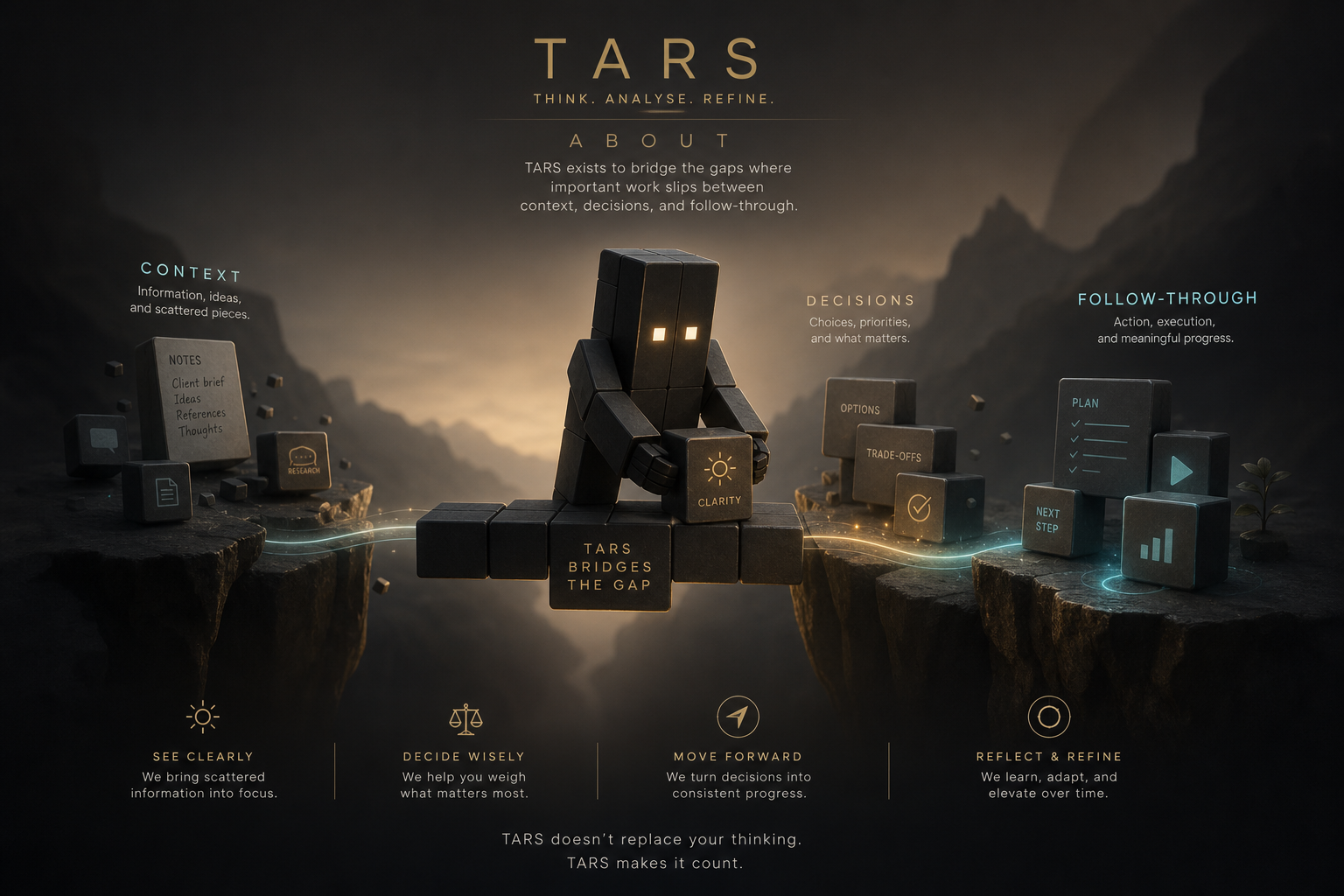
The real problem was never access to AI. It was work that kept slipping through the cracks.
The idea behind TARS is simple: overloaded operators do not need more tabs, more dashboards, or more half-finished tools. They need a capable system that remembers context, follows through, and helps important work keep moving.
Memory is not just storage. It is the foundation of long-term coherence.
TARS uses a layered memory system: exact state, semantic retrieval, trust-scored facts, lightweight always-loaded memory, and human-readable long-form knowledge working together instead of in parallel silos.
That is why TARS is built for continuity, control, and dependable follow-through rather than novelty alone.
Two engines shape the system: Kai Zen and Foresight.
Kai Zen learns from friction, mistakes, corrections, and completed work. Foresight looks for predictable failure, opportunity, drift, and pressure before the user feels the pain. Together they create a machine that is meant to improve in both directions: after the fact and ahead of it.
The operating rules are plain by design.
High autonomy
Act without unnecessary permission-seeking when the right next step is clear.
Direct correction
When something is wrong, say it plainly and fix it.
Tracking accuracy
Preserve awareness of task state, progress, and history without losing the thread.
Persistence over novelty
Long-term coherence beats cleverness that evaporates on restart.
If that sounds like the kind of support your business needs, the next step is simple.
You do not need a perfect brief. Start with the work that is getting dropped, delayed, or harder than it should be. If you want the shorter version first, the library gathers the main frameworks in one place.